"Unhappy man! Do you share my madness? Have you drunk also of the intoxicating draught? Hear me - let me reveal my tale, and you will dash the cup from your lips!" - (Frankenstein - p. 12)
Just finished painting my nails.
The letters of the novel present an interesting frame story about a man who is extremely similar to Victor, the main character of the central story. Just as Victor, Walton is a man of ambition who seeks personal success within the scientific field; however, Victor seeks to tell his tale to warn Walton of scientific breakthroughs leading to personal downfalls. The excerpt above is the turning point of the frame story - when Victor decides to finally tell his story to Walton.
In the passage above, Shelley uses a metaphor to compare a scientific dream to a luxurious glass of wine. Just like wine, the dream seems to be good on the surface. But eventually, wine and overindulgence can lead to negative effects. After drinking too much wine, a person becomes drunk. In Victor's case, his obsession with animating a corpse causes the creation of a supposed evil creature (I am still not totally convinced the creature is evil). Victor sees that Walton has the same ambition and wishes to warn him of inquiry of knowledge.
Amanda: "I've seen such pitiful casses in the South - barely tolerated spinsters living upon the grudging patronage of sister's husband or brother's wife! - stuck away in some little mouse-trap of a room - encouraged by one in-law to visit another - little birdlike women without any nest - eating the crust of humility all their life!" ("The Glass Menagerie" Scene 2 - p. 1243)
In "The Glass Menagerie," Laura suffers from many different obstacles. At the beginning of the story, we find that Laura is crippled and wears a leg brace. Later, Laura reveals that she dropped out of business school because of her shyness. Laura has an extremely hard time fitting in with society; I believe she has a mental condition such as autism which causes her to be timid and obsessed with one thing such as the glass horse.
In the excerpt above, Amanda, Laura's mother, tells Tom her worries about Laura. Amanda is worried that Laura will never find a husband and spend her life dependent on the family. Amanda uses a metaphor to describe her daughter as a lost bird without any nest. Amanda worries that without a feeling of belonging, Laura will possess low self-esteem; however, this is ironic because Laura already possess a low-esteem due to her mother's pressure and outlandish actions.
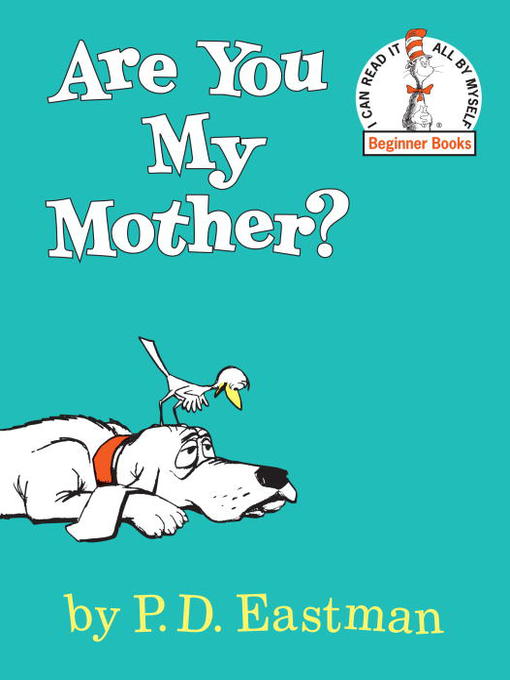
This part of the story reminds me of a Dr. Seuss book called "Are You My Mother?" Throughout the story, the little bird tries to find its' home and family just as Laura attempts to find a husband she can belong to.
"...but I was being attached to the party to act as a brake on Father. As a brake I had never achieved anything, but Mother still had great faith in me." (p. 344)
Throughout "The Drunkard," the author uses an image of brakes. For example, in the excerpt above, Larry describes his presence at the funeral as "brakes" on his Father. Larry states that he had never actually stopped his father from drinking before, but his mother still believed he would. It was almost as if she knew what was going to happen. This metaphor is ironically played out. To prevent his father from drinking, Larry (as a young child) finds himself drunk, distracting his father from his alcohol addiction. Larry has no intention of becoming drunk or stopping his father from drinking. This irony adds an element of humor to the story even though alcoholism is a completely serious issue. At the end of the story, Larry's mother credits her young child for saving her husband by protecting him from alcohol. I thought it was humorous that she did not even care about her son getting drunk; she was only worried about his father.
"I see myself on deck, convinced
his ship's gone down, while he's convinced
I'll see him on the dock..."
("Elegy for My Father, Who Is Not Dead" - Andrew Hudgins)
I'm beginning to love poems where the title tells me exactly what to expect. However, this poem is a little misleading. When I think of a elegy, I imagine a sad, nostalgic speech describing the good qualities of a recently deceased person. Obviously, the speaker's father is not dead, but he is approaching death. Maybe he has some type of illness that is threatening his life, or he is just approaching old age. Either way, the speaker has a subdued or indifferent approach on his father's death.
Many differences are pointed out between the beliefs of the father and the speaker. For example, the speaker does not really believe in the afterlife. In the excerpt above, the father's belief in the afterlife is described using a metaphor. The father compares the afterlife to a journey specifically made on a ship. While the father believes his ship will stay afloat, the speaker believes the ship will sink after death. The speaker shows that he is not completely confident by using the phrase "I think" instead of "I know." In reality, no human being can really fully comprehend the afterlife. In admitting this, the speaker is admitting that his father could be right; however, the speaker still has a pessimistic attitude.
"I hope to see my Pilot face to face
When I have crossed the bar."
("Crossing the Bar" - Alfred, Lord Tennyson)
I was trying to figure out what the word "bar" means in this poem. Obviously, it metaphorically represents some sort of barrier the speaker must cross after death in order to reach heaven. However, I thought that the word may have a definition associated with the sea. Apparently, a type of seabird is called a "sea bar" or "tern." I found this interesting because maybe the word "bar" is used in more than one context. The speaker literally wants to cross the bar in order to reach heaven; however, the "mourning of the bar" can represent a bird's call as it flies along the beach. These birds metaphorically represent those who mourn for a person who has died.
In the excerpt above, the word "pilot" is capitalized. At first, I thought this was just a thing with poets. Emily Dickinson capitalizes all of her nouns, so everyone else should too, right? Well, upon closer examination, the pilot in this poem is metaphorically referring to God. In our life, God is the one who choses when we will join his kingdom and what will happen to us. The speaker is trying to prove to his loved ones that mourning loss after death is pointless because God has carved a pathway for each and every person on Earth. Describing God as a pilot is appropriate because the speaker is putting "out to sea" in the first stanza and embarking on a journey in the third stanza. In both scenarios, a pilot is needed in order to guide the way.
"I thought about Hailsham closing, and how it was like someone coming along with a pair of shears and snipping the balloon strings just where they entwined above the man's fist. Once that happened, there'd be no real sense in which those balloons belonged with each other any more." Never Let Me Go (p. 213)
I think clowns are extremely ironic. The one and only purpose for a clown is to create happiness; however, many people are afraid of clowns. I think it is no mistake that Ishiguro used this image to create a metaphor. In a way clowns are mysterious - after all, you never know what they might do next and their identity is usually sealed. In the same way, Hailsham's closing was a type of mystery. Hailsham, a place of happiness and dreams, scared many people who did not know what exactly made this school so special.
The excerpt I found was part of a metaphor comparing the closing of Hailsham to the snipping of the strings of balloons. The balloons actually represent the students of Hailsham who are connected by the very existence of the school. Without a common denominator, people tend to drift apart. Even though this has already happened, Kathy is still upset. Hailsham is her last chance to hold on to the past,of sharing that escape from reality with others. But now that this is gone, Kathy has to face the world alone. But really, I think that everyone who attended Hailsham will always remember their experiences. Nothing that is truly meaningful ever actually leaves a person's memory no matter how hard he or she tries to forget. However, the closing of Hailsham is like a closing of a big part of Kathy's life. When one chapter ends, another begins.